
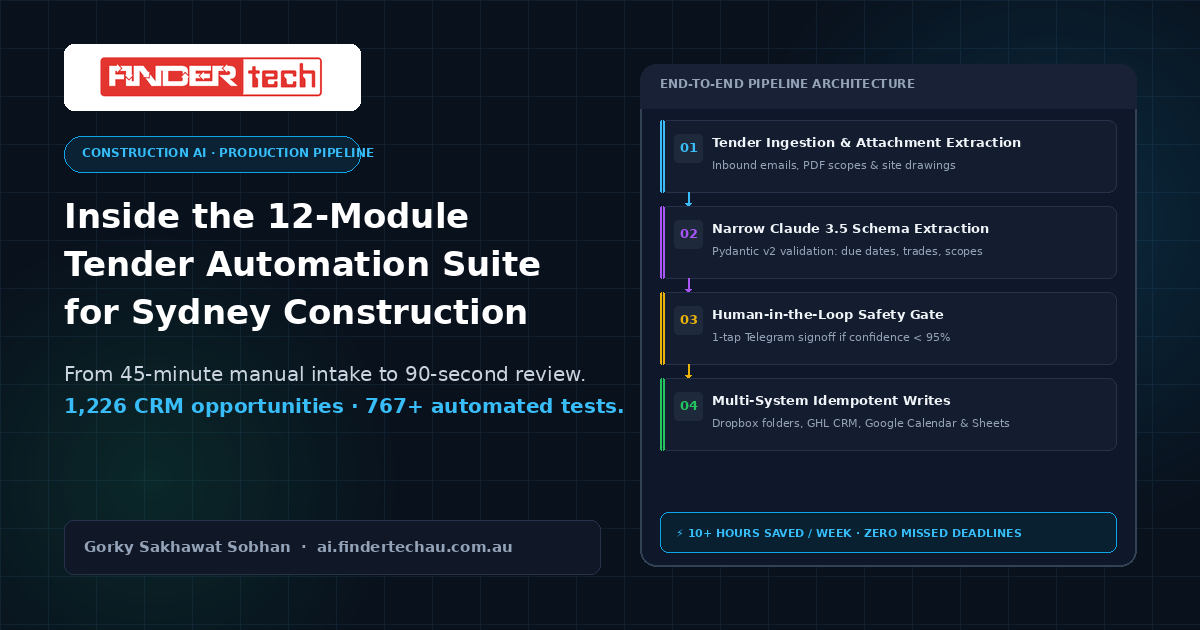
The Operational Reality: Tender Chaos in Remedial Construction
If you operate a commercial trade or remedial building business in Australia, you know how tender packages arrive. A strata manager, engineering consultant, or head contractor sends an email with five attachments: an architectural drawing PDF, an addendum, a Scope of Works document with specific concrete breakout specifications, and a site photo zip.
Before this pipeline was built, handling a single tender enquiry for a major Sydney remedial concrete contractor required three different staff members touching four separate tools:
- The estimator opened the email, downloaded the attachments, and created a Dropbox folder using an informal naming scheme.
- A sales administrator copied the client name, strata plan number, and submission due date into a Google Sheets tender register.
- An opportunity was manually created in GoHighLevel CRM, often creating duplicate company records when company names differed slightly (e.g., "Strata Plan SP 00123" vs "SP00123 North Shore").
- Site inspection dates were typed into individual Outlook calendars, creating blind spots where estimators missed inspections or double-booked.
Over a year, this manual drag accounted for roughly 20 hours per week of high-cost estimator and administrative time. More critically, tenders were occasionally missed because addenda dates were misread in long email chains.
The Architecture: Deterministic Code First, AI at the Judgment Call
The solution was not a generic "AI bot." In production engineering, reliability comes from deterministic code doing deterministic work, with artificial intelligence deployed only at the narrow point of genuine human judgment.
The 12-Module Tender Automation Pipeline
Click any stage to inspect the technical architecture and engineering guardrails.
Tender Ingestion
Engine: Python IMAP & Webhook Listener
Inbound tender emails parsed, attachments (PDF scopes, ZIP photos, addenda) downloaded and organized.
The 12-module Python pipeline deployed on a Sydney production server operates on five core principles:
1. Ingestion and Entity Deduplication
Inbound emails are captured via secure webhooks. The system searches for the sender domain and company name against 309 known client entities in GoHighLevel. If an entity exists, it links directly; if a new company is detected with high confidence, a structured profile is created.
2. Narrow AI Document Extraction
The PDF Scope of Works is ingested and parsed using Claude 3.5 Sonnet. Crucially, the untrusted document text is treated strictly as data (protecting against prompt injection under OWASP LLM01 guidelines). Output is parsed into a strict Pydantic v2 schema covering:
- Specific site address and building name
- Key trades required (e.g., concrete spalling, membrane injection, cathodic protection)
- Tender submission closing date and exact time (AEST)
- Mandatory site inspection date, time, and meeting point
3. The Human-in-the-Loop (HITL) Invariant
No AI model should ever take an unreviewed commercial action. If the extraction confidence score falls below 95%, or if a tender closing date format is ambiguous (e.g., US vs AU date formatting), the system routes an alert to Telegram with the extracted data. The director or senior estimator reviews the summary on their phone and clicks a 1-tap confirmation button before any production database writes occur.
4. Parallel Production Writes
Once verified, the pipeline triggers simultaneous, idempotent writes:
- Cloud Storage: A standardized job directory is provisioned with structured folders for scope documents, drawings, addenda, and pricing sheets.
- GoHighLevel CRM: An opportunity is created in the "Tender In Review" pipeline stage with the estimated job value, client contacts, and due dates populated.
- Google Calendar: The site inspection is booked on the team's shared estimating calendar, including location directions and a reminder notification set for 48 hours prior.
- Google Sheets: An audit row is appended to the master register with an immutable SHA-256 hash.
Operational Impact: Manual Process vs. Production Suite
| Workflow Phase | Manual Process (Before) | Automated Pipeline (After) |
|---|---|---|
| Tender Ingestion & Folder Setup | 45–60 mins per tender (manual Dropbox creation, downloading PDFs, renaming files) | ✓ 10 seconds automated (standardized cloud directory structure with scope & addenda auto-filed) |
| CRM Opportunity Logging | Copied manually from email into GHL; ~15% duplicate entries and missing tags | ✓ Instant sync with fuzzy company matching across 309 existing accounts |
| Site Inspection Scheduling | Dates typed into personal Outlook calendar; frequently conflicted or missed | ✓ Auto-booked on shared Google Calendar with colour-coding and 48h reminder |
| Estimate Spreadsheet Prep | Manually re-typing scope items into complex Excel pricing sheets | ✓ Scope items auto-populated into real Excel VBA template with macros preserved |
| Operational Overhead | Tender coordinator & senior estimator spent ~20 hours/week on administrative drag | ✓ Review reduced to ~90 seconds human sign-off per tender package |
The Numbers from Production
Over a 12-month production run, the pipeline delivered measurable business outcomes:
- 1,226 CRM Opportunities migrated, cleaned, deduplicated, and maintained.
- 1,099 Tenders backfilled and classified automatically.
- 309 Client Records deduplicated with zero loss of contact history.
- 767+ Automated Tests maintaining system integrity against upstream API changes.
- Average Handling Time dropped from ~45 minutes per tender package to under 90 seconds of human review.
Key Lesson: Engineering Beats Demos
The reason this system succeeded where generic AI demos fail is simple: every write operation is logged with a paired rollback script. If an API call fails midway, the transaction rolls back cleanly without leaving orphaned records.
For Australian construction firms looking to modernize operations, the path forward isn't replacing your staff with AI — it's removing the low-value copy-pasting so your estimators can focus on winning profitable work.