
The $15M Operational Ceiling
Most growing Australian businesses in commercial plumbing, electrical contracting, industrial roofing, civil trade, and remedial construction hit a familiar roadblock between $5 million and $30 million in annual turnover.
Whether you manage a 25-van commercial plumbing outfit, coordinate roofing crews facing strict SafeWork NSW height regulations, or deploy sparkies across multi-site commercial projects, the operational friction looks remarkably similar:
In the early days, scrappy manual processes worked: a couple of Google Sheets, construction and job management software like Procore, simPRO, or ServiceM8, an accounting system like Xero, and a mountain of WhatsApp messages and email threads.
But as van fleets expand past 15 vehicles, field headcount crosses 30 trades, and transaction volumes surge, the cracks appear:
- Plumbers & Drainage Contractors: Endless manual data entry converting inbound strata and builder work orders into job cards, while high-value press-fit tools, drain cameras, and utility vehicles sit in field transit without real-time GPS tracking or inventory logs.
- Roofers & Height Safety: Heavy SafeWork NSW compliance overhead — paper-based working-at-height SWMS, daily harness checkoffs, site hazard inductions, and weather-delayed job re-rostering managed through chaotic text threads.
- Sparkies & Electrical Contractors: Disconnected hours tracking — reconciling sparkies' travel time and hours against job site geofences, paper compliance certificates (CCEW), and manual double-handling into Xero Payroll.
- Remedial & Civil Builders: Double and triple-handling of tender packages, scopes of work, variation approvals, and supplier invoices across disparate software portals.
- Back-Office Firefighting: Critical operational knowledge locked in the heads of one or two senior coordinators who are overwhelmed with administrative firefighting, unable to architect sustainable automation.
At this inflection point, business owners traditionally look at two expensive options — both of which often fail.
The Flawed Traditional Dilemma: Full-Time Hire vs. Digital Agency
Option A: The Full-Time Systems Manager ($175,000+ Liability)
A senior solutions architect or systems manager in Australia currently commands a base salary between $140,000 and $175,000. When you add statutory employer on-costs:
- 11.5% Superannuation Guarantee: ~$17,250
- NSW Payroll Tax (~5.45%): ~$8,700
- Workers' Compensation & Recruitment Fees: ~$12,000–$25,000
- Leave Entitlements & Payroll Risk: 4 weeks annual leave, personal leave, and long-term overhead.
Your all-in annual employer liability quickly exceeds $180,000 to $200,000. For a mid-market firm, carrying that fixed overhead is a substantial risk. Furthermore, senior systems architects often complete the heavy foundational integrations in the first six to nine months, after which they risk becoming an underutilized, expensive full-time resource.
Option B: The Traditional Digital Agency (Hourly Billing Trap)
The alternative is hiring an IT consultancy or software agency. Agencies typically bill by the hour ($180–$280/hr) with multi-month scoping phases, junior developers doing the actual implementation under senior oversight, and an inherent commercial incentive to build proprietary lock-in rather than empowering your team.
The Third Path: Fractional Systems & AI Advisory
The fractional model bridges this gap. Instead of hiring a full-time headcount or entering an open-ended agency contract, you engage a principal systems architect on a committed monthly retainer — typically 4 dedicated delivery days per month, accompanied by ongoing asynchronous oversight.
Discovery & Data Cleaning
Audit existing tools, identify API constraints, clean dirty spreadsheet records, and prioritize the highest-impact bottleneck.
Core Integration & Error Handling
Deterministic Python/TypeScript builds connecting CRM, ERP, and cloud storage with paired rollbacks so data is never lost.
Narrow AI & Human Safety Gates
Deploying schema-validated AI extraction with mandatory human verification before any commercial actions execute.
Team Adoption & Enablement
Hands-on testing with coordinators, workflow documentation, and gradual rollout to ensure your team actually adopts the system.
A Practical, Phased Delivery Framework
In systems engineering, sustainable results do not come from rushed "magic in 4 days" promises. Instead, we work systematically through four pragmatic delivery phases:
- Phase 01 — Discovery & Data Cleaning: Before automating anything, we audit your actual data flows, API permissions, and spreadsheet clutter. We clean duplicate accounts and identify the single highest-value bottleneck.
- Phase 02 — Core Integration & Error Handling: We build deterministic, test-backed pipelines connecting your tools (CRM, telematics, job management, accounting). Every integration includes automated rollbacks and error logging so data is never lost.
- Phase 03 — Narrow AI with Human Safety Gates: Where unstructured text or PDFs slow down operations (e.g. tender scopes, SWMS compliance, or supplier bills), we deploy schema-validated AI models. Crucially, human approval gates ensure zero unverified automated actions.
- Phase 04 — Team Enablement & Sustainable Adoption: We work directly with your operational coordinators, test real edge cases together, and ensure your team understands and owns the workflow long-term.
Across the engagement, continuous asynchronous monitoring ensures your pipelines run smoothly, with direct architectural guidance on Slack and email.
The Economics: Senior Capability at ~35% of the Cost
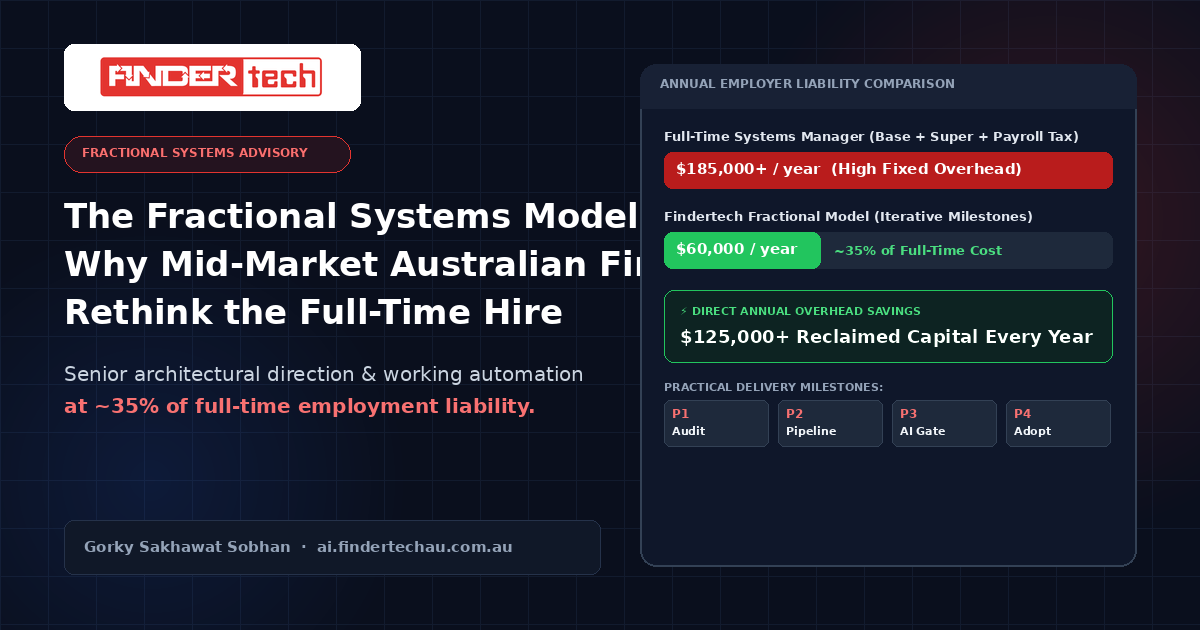
A dedicated monthly fractional retainer typically equates to roughly a third of full-time employment liability.
Compared to a full-time headcount liability of $175,000+, this delivers direct payroll liability savings of over $100,000+ per year — while delivering immediate senior execution from day one with zero recruitment delays or long-term employment risk.
*(Note: Market compensation benchmarks based on Australian salary data. Individual business requirements and operational savings vary on a case-by-case basis).*
Who This Fits Best: High-Leverage Trade & Field Operations
The fractional systems architecture model and our connected Checbox/Finder GPS ecosystem are specifically tailored for:
1. Commercial Plumbing & Drainage Contractors: Managing 10 to 30+ service utes across metro and regional territories. Automating strata and builder work-order intake, securing vehicles and high-value drain diagnostic tooling with real-time Teltonika 4G telematics, and digitizing compliance sign-offs with zero manual paperwork.
2. Commercial & Industrial Roofers: Operating under strict SafeWork NSW working-at-height regulations. Automating daily mobile SWMS sign-offs, harness and anchor-point checkoffs, site hazard inductions, emergency storm call-out dispatch, and photo documentation without administrative double-handling.
3. Commercial Electricians & Sparkies: Deploying service vans on active commercial jobsites. Eliminating unverified overtime and paper timesheets through Checbox SiteLog (`sitelog.checbox.com.au`), matching van arrival timestamps with geofenced site attendance, and pushing approved hours straight into Xero Payroll.
4. Remedial Builders & Civil Subcontractors: Running on Procore, simPRO, ServiceM8, GHL, and Xero. Drowning in tender packages, scopes of work, and variation approvals, needing schema-validated AI extraction and automated project folders without locking into bloated $50–$150/user monthly software contracts.
5. Transport, Freight & Distribution Fleets: Requiring automated order intake, electronic proof-of-delivery (ePOD) with digital signatures, live delivery confirmation, driver route compliance, and temperature/humidity logging — delivering market-standard operational power while drastically optimizing software licensing overhead.
Flexible Engagement Models: From Direct Advisory to Full Delivery Teams
Every business is at a different operational stage. Depending on your internal capacity, we structure our work to meet your exact requirements:
- Targeted Live Consultations & System Audits: Engage me directly for 1-on-1 diagnostic sessions to evaluate software investments, review architecture blueprints, or untangle specific API bottlenecks.
- Ongoing Fractional Retainer (Principal-Led): High-level systems leadership, strategic oversight, and hands-on pipeline engineering embedded into your monthly operational rhythm.
- Full Dedicated Project Delivery Teams: For mid-market companies executing major digital transformations or custom platform builds, I deploy and lead a dedicated team of specialized software engineers and dedicated project managers. You get enterprise-grade execution, rigorous quality assurance, and single-point architectural accountability without the overhead of building an in-house tech department.
Whether you need strategic advisory for your executive team or a dedicated delivery squad managed end-to-end, the focus remains the same: practical, resilient systems that eliminate manual drag and scale your operations.